Beyond the Desk: Why a Thoughtful Office Transformation is Your Secret Weapon
29/09/2025
Is the Purity of Your Drinking Water a Top Priority for You?
22/07/2026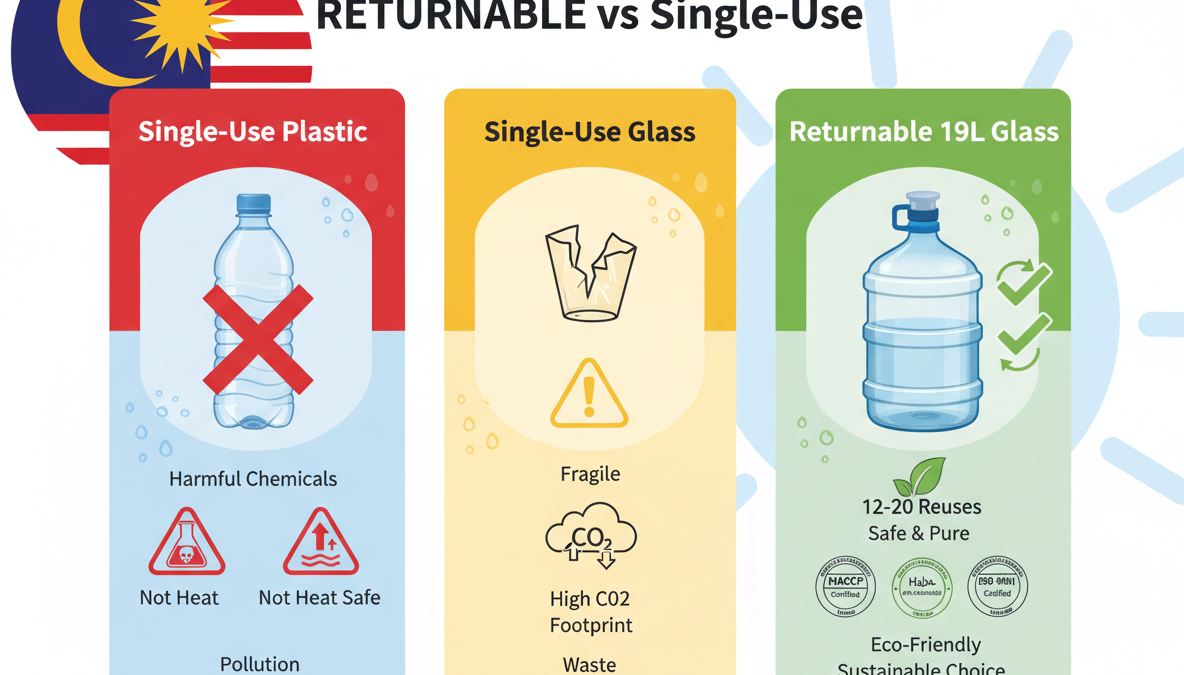
When it comes to choosing water for your home or office in Malaysia, you’ve probably heard conflicting advice about plastic bottles. Are they really dangerous? Is glass always better? Let’s separate fact from fiction and help you make an informed decision for your family or business.
The Truth About Chemicals in Plastic Water Bottles
Myth #1: All plastic bottles leach dangerous chemicals into your water
Here’s what the science actually says: while single-use plastic bottles can leach chemicals like BPA, phthalates, and microplastics—especially when exposed to heat or sunlight—the real concern is how the bottles are used and stored.
According to recent 2024 research, approximately 16,000 chemical additives are found in various plastics, with 4,200 known to be harmful to human health. Studies have found hundreds of thousands of plastic particles in bottled water, including PFAS (forever chemicals) that pose serious health risks.
The key takeaway? Single-use plastic bottles are fine for emergencies, but they’re not designed for daily, long-term use—especially in Malaysia’s hot climate where heat accelerates chemical leaching.
Glass Bottles: The Environmental Surprise You Didn’t Expect
Myth #2: Glass bottles are always more environmentally friendly than plastic
This might shock you, but multiple studies—including research from the BBC and University of Michigan—have found that single-use glass bottles actually have a higher environmental footprint than plastic in many categories.
Here’s why:
- Energy-intensive production: Glass requires furnaces heated to 1500°C (2732°F) to melt raw materials, consuming significantly more energy than plastic production
- Heavy transportation: Glass bottles are heavier, requiring more fuel for delivery and generating higher carbon emissions
- Mining impact: Silica sand extraction for glass production causes land deterioration, biodiversity loss, and contributes to the global sand shortage
- Recycling challenges: While glass is infinitely recyclable in theory, the remelting process accounts for 75% of energy consumption during production
The glass and container industries emit over 60 megatonnes of CO2 per year globally.
checkout this article by BBC > Glass Or Plastics Good for the environment
The Game-Changer: Returnable vs Single-Use
Here’s where the conversation completely shifts: The real environmental winner isn’t about glass vs plastic—it’s about reusable vs single-use.
Returnable glass bottles (like the 19L bottles used by water delivery services) can be reused 12-20 times before recycling, dramatically reducing their environmental impact. When glass bottles are part of a refill system, they become one of the most sustainable packaging options available.
Why returnable glass bottles win:
- Reuse eliminates waste: No constant production of new bottles
- Professional handling: Bottles are properly cleaned, sanitized, and maintained
- Quality preservation: Glass is non-toxic and doesn’t leach chemicals, even with repeated use
- Long-term cost savings: Lower per-liter cost compared to single-use bottles
What About Microplastics?
Myth #3: You can completely avoid microplastics by switching to glass
While it’s true that plastic bottles contribute to microplastic exposure, Stanford Medicine research confirms that avoiding microplastics entirely is impossible in our modern environment. They’re in our air, food, and water supply.
However, you can significantly reduce your exposure by:
- Avoiding single-use plastic bottles for daily drinking water
- Choosing returnable glass bottles from certified suppliers
- Never reusing single-use plastic bottles
- Keeping plastic bottles away from heat and direct sunlight
The Malaysian Context: Heat, Humidity & Water Safety
Malaysia’s tropical climate adds another layer to this conversation. Our average temperatures (25-35°C) accelerate chemical leaching from plastic bottles, making single-use plastic bottles particularly risky for:
- Bottles stored in cars or warehouses
- Water kept at room temperature for extended periods
- Bottles exposed to direct sunlight during delivery
This is why many Malaysian offices, hospitals, government departments, and businesses—including Bank Negara, KPJ Hospital, and major automotive service centers—choose returnable glass bottle delivery services.
Making the Smart Choice for Your Home or Office
Based on the evidence, here’s the hierarchy of water bottle choices from best to worst:
Best: Returnable glass bottles with professional delivery service
- Reused 12-20 times
- HACCP and Halal certified water
- Professional cleaning and maintenance
- Lowest long-term environmental impact
- No chemical leaching concerns
Good: Personal reusable bottles (glass or stainless steel)
- Reduces single-use waste
- Requires consistent cleaning
- Convenient for on-the-go
Acceptable for emergencies only: Single-use plastic bottles
- High environmental impact
- Chemical leaching risks
- Not designed for reuse or long-term storage
Worst: Reused single-use plastic bottles
- Increased chemical leaching with each use
- Bacterial contamination risks
- Degraded plastic releases more microplastics
The Bottom Line: It’s Not Glass vs Plastic—It’s Reusable vs Single-Use
The plastic vs glass debate misses the bigger picture. The real question is: Are you using single-use containers or participating in a reusable system?
For Malaysian homes and offices, returnable glass bottle delivery services offer:
- ✅ Safer drinking water (no chemical leaching)
- ✅ Lower environmental impact (through reuse)
- ✅ Better value (lower cost per liter)
- ✅ Convenience (scheduled delivery and maintenance)
- ✅ Quality assurance (certified processing and cleaning)
Single-use bottles—whether plastic or glass—create unnecessary waste, cost more over time, and carry higher environmental footprints.
Ready to Make the Switch?
If you’re currently buying single-use bottled water for your home or office in Johor Bahru it’s time to consider a smarter, safer, and more sustainable solution.
Returnable glass bottle delivery gives you:
- Premium vapor-compressed water that meets HACCP, ISO, and Halal standards
- Scheduled deliveries (weekly to monthly based on your needs)
- Free equipment maintenance with 2-day repair response time
- The peace of mind that comes with 30+ years of trusted service
Don’t settle for the health risks of single-use plastic or the environmental impact of single-use glass. Choose a water delivery service that prioritizes your health, your budget, and our planet.
Contact Pure Water to learn more about our returnable glass bottle delivery service, office pantry supplies, and complete beverage solutions for Malaysian businesses and homes.
Pure Water Malaysia has been delivering premium bottled water across Johor Bahru, Kuala Lumpur, and Penang since 1991. Our HACCP, ISO, and Halal certified water is trusted by government departments, hospitals, banks, and leading businesses throughout Malaysia.